
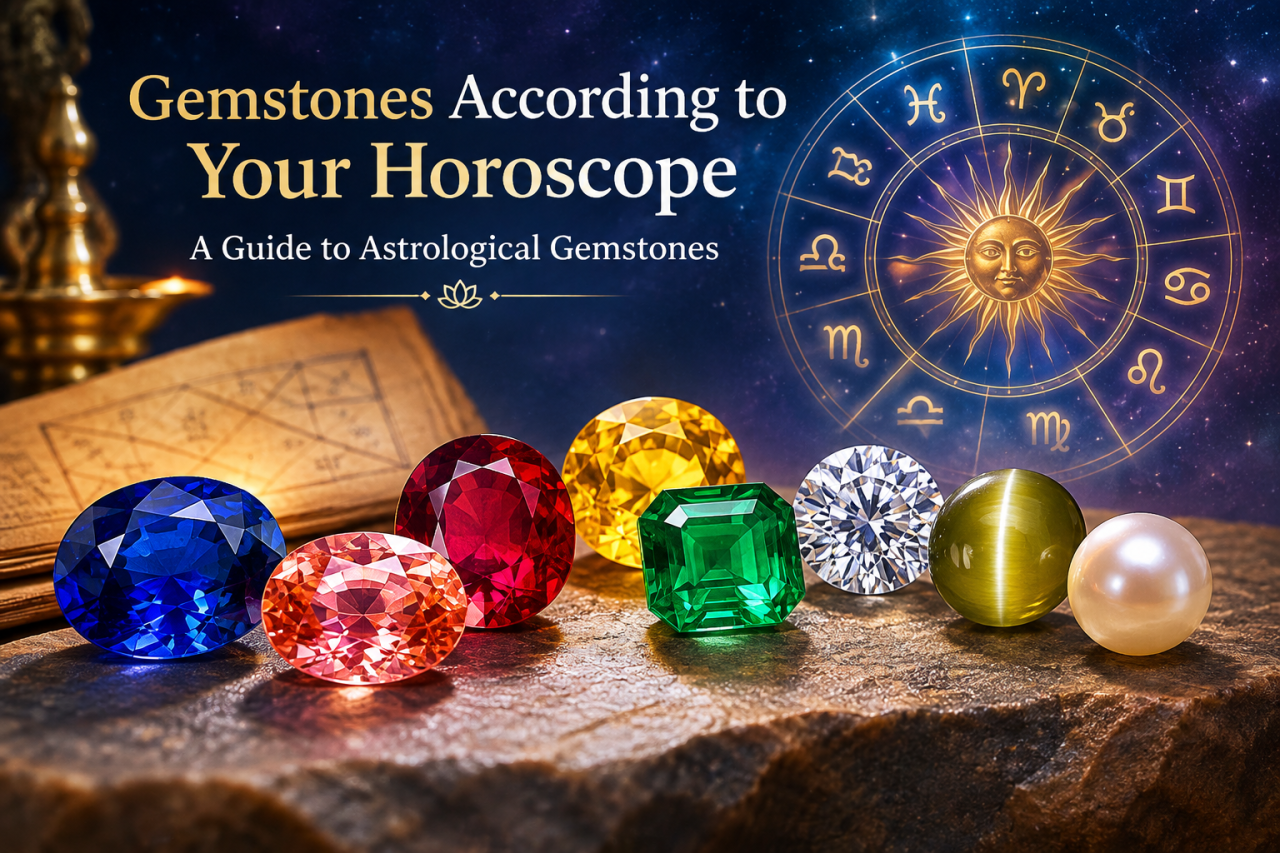
A Guide to Choosing the Right Gemstones According to Horoscope
For centuries, gemstones have been an important part of astrology, especially in Vedic and Sri Lankan traditions. In Jyotish astrology, certain gemstones are connected with the nine planetary influences, known as the Navagraha. Many people believe that wearing the right gemstone can help strengthen the positive qualities associated with a particular planet.
However, choosing a gemstone is not simply about looking at your zodiac sign and picking a stone from a chart. Traditionally, astrologers consider your birth chart, planetary positions, Ascendant (Lagna), and the overall strength of the planets before recommending a gemstone.
This is why a gemstone that may be suitable for one person may not necessarily be the right choice for someone else.
Understanding Gemstones in Astrology
In traditional Vedic astrology, the nine principal planetary influences are connected with specific gemstones. These are commonly known as the Navaratna, or nine gemstones.
| Planet | Traditional Gemstone | Common Colour |
|---|---|---|
| Sun (Surya) | Ruby | Red |
| Moon (Chandra) | Pearl | White |
| Mars (Mangala) | Red Coral | Red / Orange |
| Mercury (Budha) | Emerald | Green |
| Jupiter (Guru) | Yellow Sapphire | Yellow |
| Venus (Shukra) | Diamond | Colourless / White |
| Saturn (Shani) | Blue Sapphire | Blue |
| Rahu | Hessonite Garnet | Honey / Orange-Brown |
| Ketu | Cat’s Eye Chrysoberyl | Greenish-Yellow / Brown |
Among these, Ceylon Blue Sapphire, Ceylon Padparadscha Sapphire, Ceylon Chrysoberyl Cat’s Eye, and other Sri Lankan gemstones are particularly valued because Sri Lanka has a long and internationally recognised gemstone-mining tradition.
Why Your Horoscope Matters When Choosing a Gemstone
Your zodiac sign alone does not tell the complete story.
In traditional astrology, an astrologer may examine:
- Your date of birth
- Exact time of birth
- Place of birth
- Ascendant (Lagna)
- Moon sign
- Planetary positions
- Strength of individual planets
- Beneficial and challenging planetary influences
- The houses ruled by each planet
- Current planetary periods (Dasha)
- Planetary transits
For this reason, a gemstone should ideally be selected after examining the complete horoscope rather than simply choosing a stone based on your Sun sign.
The Nine Traditional Gemstones
1. Ruby – Gemstone of the Sun
Ruby is traditionally associated with the Sun (Surya).
In astrology, the Sun represents qualities such as leadership, confidence, vitality, authority, individuality and recognition. Ruby is traditionally recommended when the Sun is considered suitable and beneficial in a person’s birth chart.
High-quality natural rubies are valued for their rich red colour, transparency and rarity.
2. Pearl – Gemstone of the Moon
Pearl is associated with the Moon (Chandra).
The Moon traditionally represents emotions, the mind, intuition, sensitivity, comfort and nurturing qualities. Natural pearls have historically been used in jewellery and astrology, although their availability and characteristics differ significantly from those of mined gemstones.
3. Red Coral – Gemstone of Mars
Red Coral is traditionally connected with Mars (Mangala).
Mars is associated with courage, energy, determination, physical strength and initiative. Red Coral is an organic gemstone rather than a mineral, and traditional astrological recommendations generally focus on natural coral.
4. Emerald – Gemstone of Mercury
Emerald is traditionally associated with Mercury (Budha).
Mercury represents communication, intelligence, learning, business, analytical thinking and commercial skills. Natural emeralds can vary considerably in colour, clarity and treatment. A quality emerald is usually evaluated carefully before purchase.
5. Yellow Sapphire – Gemstone of Jupiter
Yellow Sapphire is traditionally associated with Jupiter (Guru).
Jupiter is connected with wisdom, knowledge, prosperity, teaching, spirituality and expansion. Yellow Sapphire is one of the most important traditional planetary gemstones and is particularly valued when it is natural, attractive in colour and accompanied by reliable certification.
6. Diamond – Gemstone of Venus
Diamond is traditionally associated with Venus (Shukra).
Venus represents beauty, luxury, relationships, art, creativity, refinement and material comforts. The quality of a diamond is generally evaluated using factors such as colour, clarity, cut and carat weight.
7. Blue Sapphire – Gemstone of Saturn
Blue Sapphire (Neelam) is traditionally associated with Saturn (Shani).
Saturn is associated with discipline, responsibility, persistence, structure, patience and long-term achievement. Blue Sapphire is one of the most famous gemstones in astrology and is also one of Sri Lanka’s most important natural gemstones.
Ceylon Blue Sapphire
Sri Lanka, historically known as Ceylon, is renowned for producing exceptional natural blue sapphires.
Ceylon sapphires have a good demand for their attractive blue colours, often ranging from lighter cornflower-style blues to deeper saturated tones.
For buyers looking for a natural Sri Lankan sapphire, it is important to consider:
- Natural or laboratory-grown origin
- Heat treatment status
- Colour
- Clarity
- Cut
- Carat weight
- Origin information
- Independent laboratory certification
Because blue sapphire is a valuable gemstone, buyers should focus on gem quality and authenticity rather than astrology alone.
For those interested in natural Sri Lankan sapphires, explore the curated collection at Ceylon Gem Atelier.
8. Hessonite Garnet – Gemstone of Rahu
Hessonite Garnet, traditionally known as Gomed, is associated with Rahu.
In Jyotish traditions, Rahu is considered a shadow planet and is associated with ambition, material desires, unconventional paths and sudden changes. Hessonite garnets are generally recognised by their characteristic honey, orange-brown or cinnamon-like colours.
As with other planetary gemstones, traditional astrologers generally recommend Hessonite only after considering the individual’s horoscope.
9. Cat’s Eye Chrysoberyl – Gemstone of Ketu
Cat’s Eye Chrysoberyl, traditionally known as Lehsunia, is associated with Ketu.
Ketu is traditionally associated with spirituality, detachment, intuition and unconventional experiences.
The most desirable feature of a Cat’s Eye Chrysoberyl is its distinct chatoyancy — a bright band of reflected light that moves across the surface of the stone as it is viewed under changing light. Fine natural Cat’s Eye Chrysoberyl is rare and can be highly valuable.
Gemstones and Zodiac Signs
Many people first encounter astrological gemstones through their zodiac sign.
For example, popular astrology guides may associate particular gemstones with Aries, Taurus, Gemini, Cancer, Leo, Virgo, Libra, Scorpio, Sagittarius, Capricorn, Aquarius and Pisces.
However, zodiac-sign gemstone charts should be treated as general guidance rather than a personalised astrological prescription.
In traditional Vedic astrology, the Ascendant and complete birth chart are usually more important than simply looking at the Sun sign.
For example, two people born under the same zodiac sign can have very different ascendants and planetary placements. Consequently, the gemstone considered suitable for one person may not be recommended for another.
Can You Wear More Than One Astrological Gemstone?
Some traditional practitioners recommend combinations of gemstones, while others advise caution.
This is because each gemstone is traditionally associated with a particular planetary influence. If two planets are considered incompatible or challenging in a particular horoscope, combining their gemstones may not be recommended within that astrological tradition.
Therefore, instead of selecting several expensive gemstones based on general online charts, it is better to consult a qualified astrologer who can examine the complete birth chart.
How to Choose a Gemstone for Astrological Use
A practical approach is:
Step 1 – Prepare your birth details – Have your accurate date, time and place of birth available.
Step 2 – Consult a qualified astrologer – Ask for a gemstone recommendation based on your complete horoscope rather than only your zodiac sign.
Step 3 – Identify the correct gemstone – Determine the gemstone traditionally associated with the recommended planet.
Step 4 – Choose natural quality – Look for a genuine gemstone with transparent information about origin and treatments.
Step 5 – Request certification – For valuable gemstones, obtain an appropriate independent laboratory report.
Step 6 – Compare quality – Colour, clarity, cut, size and treatment can significantly affect gemstone value.
Step 7 – Follow the traditional wearing method – Different astrological traditions may recommend particular metals, fingers, days and rituals for wearing planetary gemstones. Follow the method recommended by your astrologer.